
Table of Contents
What is the Average Cost of a Residential Home Elevator?
Determining the average cost of a residential home elevator requires a nuanced understanding of engineering, architectural integration, and regional market trends. For homeowners and builders in Hyderabad, this is no longer a question of pure luxury but one of long-term property utility. In the current 2026 market, the financial landscape for vertical transportation has stabilized, offering a variety of price points based on technology and design.
On average, a residential home elevator in India costs between ₹8,00,000 and ₹15,00,000. However, high-end panoramic glass lifts or specialized vacuum elevators can reach upwards of ₹20,00,000. These figures typically cover the equipment and installation but often exclude civil masonry work and statutory GST. At Exfol Friends Elevators Pvt. Ltd., we emphasize that the initial purchase price is only one component; structural readiness and long-term maintenance are equally critical to the total investment.
What is a Residential Home Elevator?
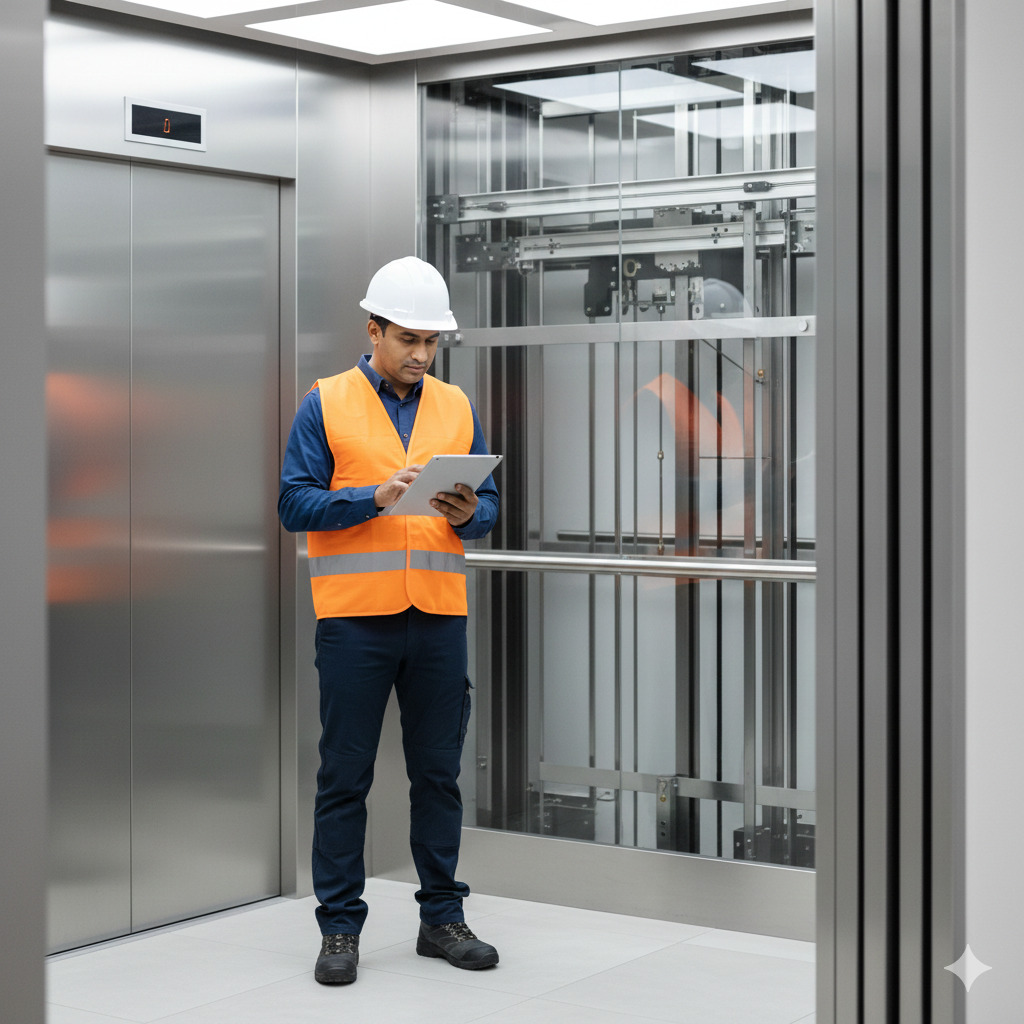
Definition: Residential Home Elevator A residential home elevator is a compact vertical transportation system designed for private use within a single-family dwelling. Unlike commercial lifts, these systems are optimized for smaller footprints (typically 12–15 sq. ft.), operate at lower speeds (0.15 to 0.3 m/s), and often require minimal pit depth and overhead clearance.
Why is a Home Elevator Important?
In the context of Hyderabad’s urban evolution, residential elevators have become a cornerstone of modern villa and duplex design.
Aging in Place and Accessibility
Hyderabad’s demographic shift towards multi-generational living in areas like Jubilee Hills and Tellapur has made accessibility a priority. A home elevator ensures that senior family members retain full access to all floors, effectively “future-proofing” the home against mobility challenges.
Real Estate Value Appreciation
In the competitive Hyderabad real estate market, a professionally installed elevator is a significant value-add. It differentiates a property in premium gated communities, often yielding a higher return on investment (ROI) by expanding the pool of potential buyers to include multi-generational families and those with specific accessibility needs.
Space Optimization in Modern Architecture
With land prices rising, Hyderabad’s residential architecture is moving vertically. Small-footprint elevators allow builders to design narrower, taller homes without compromising on the comfort of the residents.
How Does a Home Elevator Work?
The installation and operation of a residential elevator involve a precise sequence of mechanical and electrical engineering steps.
- Site Assessment and Civil Prep: Engineers determine the load-bearing capacity of the shaft and ensure the pit (the area below the lowest floor) is waterproofed and level.
- Drive System Installation: Depending on the type, either a hydraulic piston, a traction motor, or a vacuum pump is installed.
- Guide Rail Alignment: Steel rails are anchored to the shaft walls with high precision to ensure the cabin moves without vibration or noise.
- Cabin Assembly: The car is assembled within the shaft, integrating safety sensors, lighting, and communication devices.
- Control Logic Calibration: The Variable Voltage Variable Frequency (VVVF) drive is programmed to ensure smooth starts and stops, which prevents the “jerking” sensation common in older lifts.
- Safety Testing: Final protocols include testing the Automatic Rescue Device (ARD) and emergency brakes under load.
Types of Home Elevators and Their Costs
The drive system is the primary driver of the average cost of a residential home elevator.
1. Hydraulic Elevators
These use a fluid-driven piston to lift the cab. They are exceptionally quiet and popular for G+2 or G+3 villas in Hyderabad.
- Average Cost: ₹9,00,000 – ₹13,00,000.
- Pros: Smooth ride, no heavy overhead machinery required.
2. Traction (MRL) Elevators
Machine Room-Less (MRL) traction lifts use cables and counterweights. They are highly energy-efficient and suitable for taller residences.
- Average Cost: ₹8,50,000 – ₹12,00,000.
- Pros: Lower power consumption, high durability.
3. Pneumatic Vacuum Elevators
These air-driven lifts are often circular and glass-walled. They are ideal for retrofitting because they require no pit or machine room.
- Average Cost: ₹12,00,000 – ₹18,00,000.
- Pros: Minimal civil work, 360-degree visibility.

Benefits of Professional Vertical Transportation
Safety Standards and Compliance
Professional installation by a certified firm ensures adherence to the Telangana Lift Act. This includes mandatory safety features like infrared door curtains, overspeed governors, and emergency alarms.
Long-Term Value and Efficiency
Modern residential elevators are designed to consume less power than a standard household air conditioner. Using LED lighting and standby modes, these systems offer a sustainable solution for the modern home.
Ease of Maintenance
Choosing a reputable local provider in Hyderabad ensures that spare parts are readily available. Regular preventive maintenance under an Annual Maintenance Contract (AMC) keeps the system running safely for 20–25 years.
Common Mistakes and Misconceptions
Prioritizing Price Over Safety
A frequent mistake is choosing an unorganized local fabricator to save ₹1,00,000. These systems often lack certified safety gears and ARDs, posing a significant risk to the residents.
Ignoring the Hidden Costs
Many homeowners fail to budget for civil work (shaft construction, electrical wiring, pit waterproofing) and the 18% GST. A transparent quote should clearly distinguish between equipment and civil requirements.
Underestimating the Pit and Overhead Space
Not all elevators are “pitless.” Assuming any elevator can fit into any space without a technical site audit often leads to expensive structural modifications later in the construction phase.
Real-World Scenarios
Residential: The Banjara Hills Retrofit
A client in an existing three-story bungalow needed a solution for an aging parent. Since the house lacked a pre-built shaft, a pneumatic vacuum elevator was installed in the stairwell void. The installation required zero masonry work and was completed in four days, preserving the home’s aesthetics while solving the mobility issue.
Commercial/Residential Hybrid: The Gachibowli Row House
A builder developing a series of premium row houses integrated MRL traction elevators into the design. By choosing a standard 4-passenger configuration, the builder optimized costs while providing a feature that justified a 15% higher asking price per unit compared to neighboring developments without lifts.
Frequently Asked Questions
1. What is the average cost of a residential home elevator in Hyderabad?
In 2026, the average price ranges from ₹8 Lakhs to ₹15 Lakhs for standard installations, depending on the number of floors and finishes.
2. Does a home elevator require a lot of power?
No. Most modern residential elevators run on a single-phase 230V connection and consume energy comparable to a domestic microwave or air conditioner.
3. How much space is required for a 4-passenger home lift?
A standard 4-passenger lift typically requires a clear shaft area of approximately 5 feet by 5 feet.
4. Is it mandatory to get a license for a home elevator in Telangana?
Yes, under the Telangana Lift Act, every elevator must be registered and inspected by the Electrical Inspectorate to ensure it meets safety norms.
5. How long does the installation take?
Once the civil shaft is ready, the mechanical and electrical installation usually takes 15 to 25 days.
6. Can an elevator be installed in an old house?
Yes. Retrofitting is common using external glass shafts or internal staircase voids, especially with vacuum or hydraulic models.
7. What is the maintenance cost?
Annual Maintenance Contracts (AMC) for home elevators in Hyderabad typically range from ₹20,000 to ₹35,000.
8. What happens during a power failure?
Modern elevators are equipped with an Automatic Rescue Device (ARD) that uses a battery backup to bring the cabin to the nearest floor and open the doors.

Conclusion: A Balanced Approach to Home Mobility
Choosing a residential elevator is an investment in both lifestyle and infrastructure. While the average cost of a residential home elevator is influenced by technology and regional factors, the primary focus should always remain on safety and structural integrity. In a city as vertical as Hyderabad, the right elevator partner makes the difference between a functional utility and a lifelong asset.
At Exfol Friends Elevators Pvt. Ltd., we pride ourselves on delivering transparency and engineering excellence. We understand that every home in Hyderabad has unique requirements, and we are committed to providing solutions that are as reliable as they are refined.


Leave a Comment