

Table of Contents
What are the common problems with home lifts?
While the integration of home lifts has revolutionized accessibility in modern Indian residences, these complex electromechanical systems are not immune to technical hurdles. Identifying the common problems with home lifts is the first step toward ensuring long-term reliability and passenger safety. For homeowners in Hyderabad—from the sprawling villas of Jubilee Hills to the high-rise duplexes in Financial District—understanding these issues is critical to avoiding costly emergency repairs and ensuring the system remains compliant with the Telangana Lifts Act.
Most residential elevator issues stem from three primary sources: environmental factors, irregular maintenance, and power inconsistencies. Whether it is a minor door misalignment or a significant controller fault, early detection can prevent a minor glitch from escalating into a total mechanical failure. As vertical transportation technology evolves, so do the diagnostic methods. However, the fundamental mechanical principles remain consistent.
This guide provides an authoritative analysis of the technical malfunctions frequently encountered in the residential sector. By examining these problems through the lens of engineering and facility management, we aim to provide property owners and builders with a roadmap for proactive maintenance and efficient troubleshooting.
What are Common Home Lift Problems?
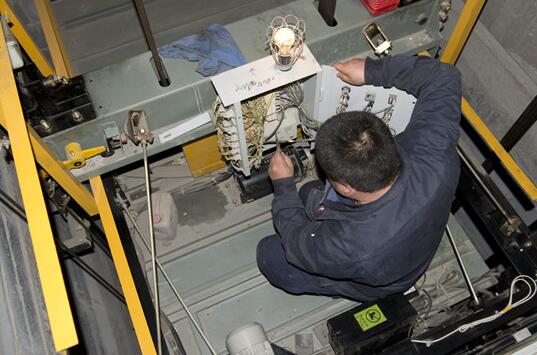
Common home lift problems refer to the technical, mechanical, or electrical failures that impede the normal operation of a residential elevator. These include leveling inaccuracies, door sensor malfunctions, power supply interruptions, and unusual noises. Such issues typically arise from wear and tear, environmental dust, or inadequate preventative maintenance schedules.
Why Understanding Lift Problems is Important
In the context of Hyderabad’s urban growth, vertical transportation is no longer a luxury but a core utility. Understanding common problems is vital for maintaining the safety and efficiency of the building’s infrastructure.
Safety of Vulnerable Passengers
Home lifts are often used by senior citizens or individuals with mobility challenges. A “minor” problem, such as a cabin stopping two inches above the floor level, can lead to serious trip-and-fall injuries. Knowing these risks allows for immediate corrective action.
Hyderabad’s Unique Environmental Factors
Hyderabad experiences significant seasonal dust and high summer temperatures. These factors can wreak havoc on sensitive electronic controllers and hoistway components. Being aware of how dust affects door tracks and sensors is essential for anyone managing a property in the Telangana region.
Compliance and Legal Liability
The Telangana Government has become increasingly strict regarding lift safety. Regular malfunctions that go unaddressed can lead to the revocation of the “License to Run a Lift.” Professional oversight ensures that the equipment stays on the right side of the law.
How Does Home Lift Troubleshooting Work?
When a lift malfunctions, a systematic diagnostic process is followed by certified technicians to restore operation:
- Error Code Analysis: Modern controllers record “fault logs.” The technician first accesses the motherboard to identify the specific error code, which points to the subsystem at fault (e.g., door interlocks or VFD drives).
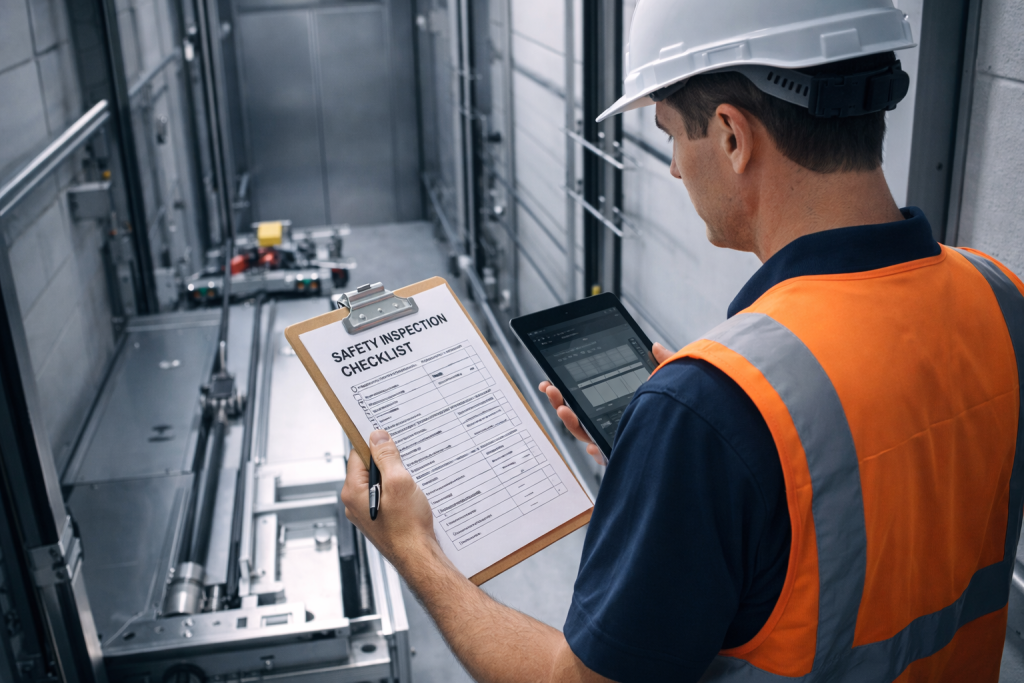
- Safety String Verification: The lift’s “safety string” is a series of switches. If one is open, the lift will not move. Technicians check each contact point, from the emergency stop to the pit switch.
- Physical Inspection: Mechanical components, such as guide rails, rollers, and ropes, are inspected for physical obstructions or excessive wear that could be causing noise or vibration.
- Power Quality Audit: Technicians measure the incoming voltage and check the Automatic Rescue Device (ARD) batteries to ensure the system is receiving stable power.
- Recalibration: Once the physical fault is cleared, the system is often recalibrated to ensure precise floor leveling and smooth door operation.
Variations: Problems Based on Lift Technology
Traction (MRL) Lift Problems
- Sheave Wear: The ropes can wear down the grooves in the drive sheave over time.
- Vibration: Poorly aligned guide rails or worn-out rollers can cause a shaky ride.
Hydraulic Lift Problems
- Fluid Leaks: Seal failure can lead to hydraulic oil leaks in the pit.
- Oil Overheating: In Hyderabad’s peak summer, the oil can get too hot, causing the lift to stop functioning until it cools down.
Vacuum/Pneumatic Lift Problems
- Seal Degradation: The airtight seals are critical; if they wear out, the cabin may not move or could descend slowly.
- Turbine Noise: Problems with the suction motor can lead to excessive noise during travel.
Benefits of Proactive Problem Management
Longevity of the Investment
A home lift is a 20-year asset. Addressing minor problems immediately prevents “cascading failures,” where a small fault in one component puts undue stress on another, significantly extending the system’s lifespan.
Efficiency and Energy Savings
A lift that is struggling with mechanical friction or poorly tuned Variable Voltage Variable Frequency (VVVF) drives consumes more power. Proper troubleshooting ensures the lift operates at peak energy efficiency.
Uninterrupted Peace of Mind
Regular maintenance and quick resolution of problems ensure that the lift is always available when needed, which is particularly crucial for multi-generational homes in Hyderabad.

Common Mistakes and Misconceptions
1. “The Lift Stopped, So the Motor is Blown”
In reality, over 70% of lift stoppages are caused by door-related issues. If the door sensor detects a tiny obstruction or if the door isn’t perfectly closed, the safety circuit breaks and the lift stops. It is rarely the motor.
2. DIY Troubleshooting
Homeowners sometimes try to force open doors or bypass safety switches. This is extremely dangerous. Lift systems are high-voltage environments with heavy moving parts; only certified professionals should handle them.
3. Ignoring Unusual Noises
A “squeak” or “clunk” is often the first sign of a problem. Ignoring these sounds leads to metal-on-metal wear, which can turn a ₹5,000 service call into a ₹50,000 parts replacement.
Real-World Scenarios
Residential: The Banjara Hills Dust Issue
A luxury villa in Banjara Hills reported that the lift doors were frequently failing to close. Upon inspection, it was found that construction dust from a nearby site had accumulated in the bottom door tracks, preventing the door from reaching its fully closed “lock” position. A simple cleaning and lubrication resolved the issue.
Commercial/Duplex: The Kokapet Power Surge
A duplex penthouse in Kokapet experienced a controller failure after a heavy thunderstorm. The lack of an external surge protector led to a voltage spike that damaged the motherboard. The installation of a dedicated voltage stabilizer and a new controller board restored operation.
FAQs on Home Lift Problems
1. Why does my home lift stop slightly above or below the floor level? This is known as a “leveling problem.” It is usually caused by a faulty floor sensor, worn-out brake pads, or an incorrectly tuned VFD drive.
2. Why are the lift doors opening and closing repeatedly? This is typically caused by a dirty infrared light curtain or a misaligned door sensor. The system “thinks” an object is in the way and reverses the doors for safety.
3. What causes a home lift to be noisy during travel? Noises are often due to dry guide rails, worn-out guide shoes, or issues with the traction ropes. Regular lubrication usually prevents this.
4. What happens if the power goes out while I am in the lift? Every modern lift should have an Automatic Rescue Device (ARD). This battery-operated system should bring the lift to the nearest floor and open the doors. If it fails, the ARD batteries likely need replacement.
5. How often should a home lift be serviced to avoid problems? In Hyderabad, we recommend a quarterly (every 3 months) preventative maintenance check to address dust and heat-related issues.
6. Can a home lift get “stuck” due to heat? Yes, particularly hydraulic lifts. If the machine room or shaft isn’t properly ventilated, the components can overheat and enter a “thermal shutdown” mode.
7. Why does the lift jerk when starting or stopping? This is usually a sign that the VVVF drive settings need adjustment or that the motor’s “S-Curve” acceleration parameters are not optimized.
8. Is it normal for a home lift to smell like burning? No. A burning smell usually indicates an electrical short, an overheating motor, or friction on the guide rails. You should stop using the lift immediately and call a technician.
Conclusion: Reliability Through Diligence
Identifying common problems with home lifts is not about highlighting failures, but about empowering owners to maintain a high standard of building safety. Vertical transportation is a marriage of mechanical strength and electronic precision; both must be nurtured through professional care.
At Exfol Friends Elevators Pvt. Ltd., we understand the nuances of the Hyderabad residential market. We believe that most “problems” are merely symptoms of a system that needs professional attention. By prioritizing quality installation and sticking to a rigorous maintenance schedule, you ensure that your home lift remains a safe, silent, and seamless part of your daily life.


Leave a Comment